

AI · Data · 22 January 2026 ·
Retrieval-Augmented Generation in plain language: the three building blocks, how it counters hallucination, and where it still goes wrong.

You have probably run into it. You ask ChatGPT something in your own field and get an answer that is… not quite right. Or worse: it sounds entirely convincing but is completely made up. Welcome to the world of AI hallucination.
Fortunately there is a fix. It is called RAG.
RAG stands for Retrieval-Augmented Generation. Loosely translated: retrieve first, generate second. It is not a standalone product or a new chatbot. It is a way of making AI work more sensibly, by connecting it to reliable sources of information.
The idea originated in 2020 at Facebook AI Research (Lewis et al., 2020). Researchers were looking for a way to make language models invent less and substantiate more. Their solution was elegant: have the AI look up relevant information first, and base the answer on that.
Since then RAG has become the standard for reliable AI applications in organisations.
Say you work at an insurer. A customer asks: “What does my travel insurance cover if I cancel?”
Without RAG the AI generates a general answer based on whatever it once learned about travel insurance. It may sound plausible, but it is not your policy. Not your terms. Not your truth.
With RAG something else happens. The system:
The difference? The answer is correct. And you can check it.
RAG consists of three parts working together:
1. The knowledge base This is where you store reliable information. Think product documentation, policy documents, manuals or approved content. These documents are split into smaller chunks and converted into so-called embeddings, mathematical representations that computers can search.
2. The retriever When someone asks a question, the retriever looks for the most relevant pieces of information in the knowledge base. This resembles search, but it is smarter: it understands meaning, not just words.
3. The generator (the language model) With the retrieved information as input, the language model formulates an answer. Crucially, the model now draws on concrete sources rather than vague recollections from its training.
The strength of RAG lies in three properties:
Reliability Answers are based on sources you manage yourself. No hallucinations about products that do not exist or prices that are wrong.
Traceability You can always check where an answer came from. That is essential for compliance, quality control and trust.
Currency Unlike a language model stuck with its training data, RAG works with information you can update continuously. New policy? Revised manual? The system knows immediately.
RAG is not a silver bullet. The quality of the output is directly tied to the quality of the input. A few common pitfalls:
A polluted knowledge base If you feed it outdated documents, duplicate versions or contradictory information, you get confusing answers. Garbage in, garbage out: with RAG too.
Poor chunking How you split documents matters. Too large and the retriever pulls in too much irrelevant context. Too small and the coherence disappears.
Wrong expectations RAG makes AI more reliable, not infallible. Human review remains necessary, certainly at the start.
You sometimes hear about fine-tuning as a way to adapt AI. That is something else.
With fine-tuning you retrain the model on your own data. The model learns new patterns and behaviour. That is powerful, but also expensive, time-consuming and hard to maintain.
With RAG the model itself stays unchanged. You only add a knowledge layer. That is more flexible, cheaper and easier to keep current. For most business applications RAG is therefore the better choice (Gao et al., 2023).
The applications are broad. A few examples:
This is arguably where the greatest value sits. To make RAG work well, you have to think about your information. Which documents are authoritative? Who owns them? What may and may not go into the knowledge base?
Those questions force organisations to get their data housekeeping in order. RAG is therefore not only a technical solution: it is a catalyst for data maturity.
RAG is an architectural principle that connects AI to reliable sources. It ensures answers are not invented but based on information you manage yourself.
It makes AI usable for real business processes. Not as a toy, but as a serious instrument.
And that always starts with a grip on your data.
Gao, Y., Xiong, Y., Gao, X., Jia, K., Pan, J., Bi, Y., Dai, Y., Sun, J., & Wang, H. (2023). Retrieval-augmented generation for large language models: A survey. arXiv preprint arXiv:2312.10997. https://doi.org/10.48550/arXiv.2312.10997
Lewis, P., Perez, E., Piktus, A., Petroni, F., Karpukhin, V., Goyal, N., Küttler, H., Lewis, M., Yih, W., Rocktäschel, T., Riedel, S., & Kiela, D. (2020). Retrieval-augmented generation for knowledge-intensive NLP tasks. Advances in Neural Information Processing Systems, 33, 9459-9474. https://arxiv.org/abs/2005.11401
About this article. We check facts and sources carefully, but cannot guarantee that they are accurate or complete. See our disclaimer.
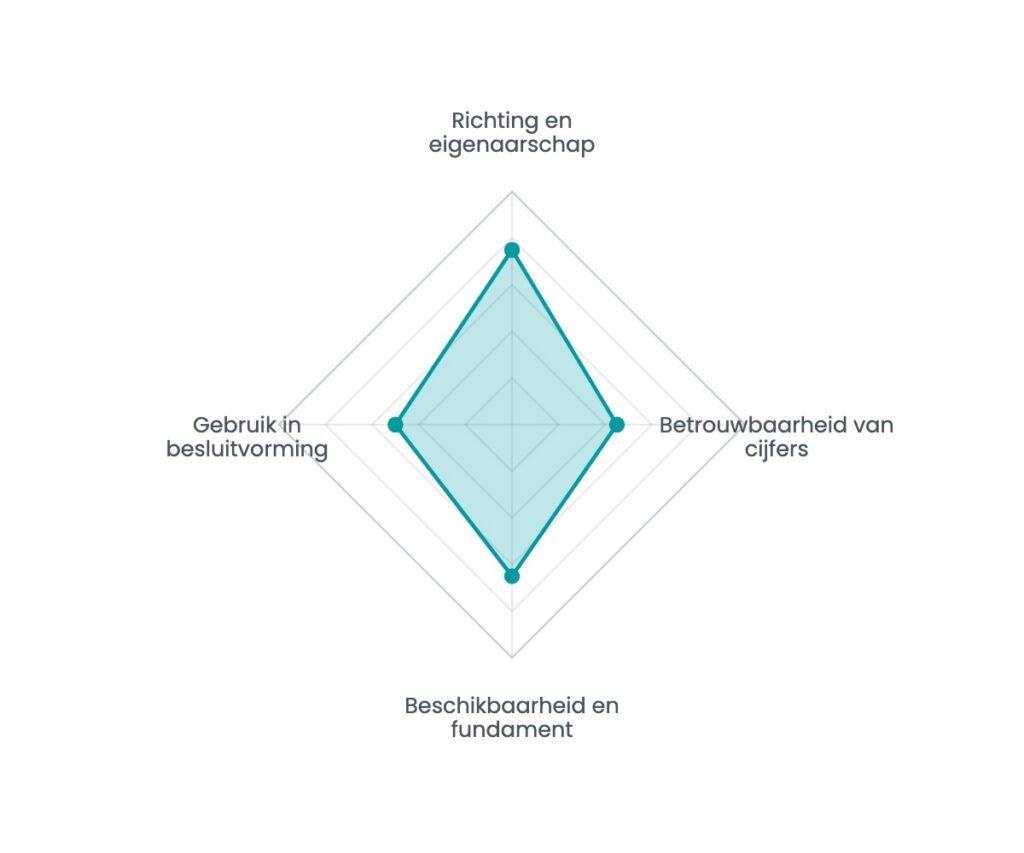
Sixteen questions, seven minutes, and an instant spider chart showing your strongest and weakest dimension. No e-mail address needed to see the result.
AI · 20 October 2026
A model that performs well in testing can deliver less than expected in practice. Learn why trust drives AI value in government and how to measure it.
Read the article →

AI · 18 October 2026
An honest checklist: six questions that determine whether your organisation is ready for AI, and what the next step is if the answer is no.
Read the article →

AI · 18 October 2026
Almost every organisation that gets serious about data faces the same question: who is actually going to do this? Build, hire or outsource?
Read the article →
Work with us
The people who build it also run it afterwards. Eindhoven, since 2014.
We use Google Tag Manager to measure visits and Leadinfo to recognise which company is visiting. Neither loads unless you agree. If you choose essential only, the site works as normal and we measure nothing. Cookie statement · Privacy statement
