

AI · 18 October 2026 ·

Translated with AI. This article was translated by an AI model from an article by Twentynext in another language, and the translation was checked automatically against the original. Verify figures and sources before acting on them. See our disclaimer.
The chances are that employees in your organisation are already using generative AI, mainly for writing and research tasks: a summary, a first draft of a memo. Ask around and you will soon hear: “Saves me an hour a day.” Then look at your quarterly figures and the question is whether you see any of that reflected there.
Whether that is a measurement problem, a matter of time or a sign that the gains evaporate along the way cannot be established from the available figures. What those figures do show is that use and governance are diverging: users say they are more productive themselves, while few organisations appear to be embedding the use or adapting the work itself. This article explains what those figures say, where the gains can evaporate between desk and balance sheet, and how to test that in your own processes.
The use is already there. A survey by Salesforce among 1,000 Dutch employees, summarised by Emerce in December 2023, shows that a quarter are experimenting with it or already using it in their work. Of those users, 60 per cent believe it increases productivity. That is self-reporting: employees assess their own productivity. The figures are almost three years old; use has very likely grown since, so read them as an early indication rather than the current situation.
At the same time, in that same survey only 14 per cent report that their own organisation has clear policy on generative AI. That too is an employee perception; how representative it is of Dutch organisations cannot be inferred from it. In any case, use appears to be running well ahead of the organisation that ought to be embedding it.
The Deloitte study Trust in generative AI, conducted among more than 30,000 European participants and discussed in Management Scope in December 2024, gives a similar picture for the Netherlands. The precise sample definition is not apparent from that discussion. Around two thirds of the Dutch population (65 per cent) are familiar with the technology; familiarity is not the same as use. Only a third of Dutch companies actively encourage its use. And according to the discussion, half of the employees who are familiar with generative AI often use the tools without explicit approval from their employer; how exactly that group is defined is not stated.
Expectations are high: 77 per cent of Dutch users think generative AI will make work easier over the next two years, and likewise 77 per cent expect it to become more enjoyable. That is an optimism you should take seriously. Whether that optimism also shows up in organisational results is another question.
In an analysis entitled Why isn’t AI delivering its promised productivity gains yet?, the author argues that there is strong evidence that generative AI makes individuals more productive, and asks why the promised gains at larger scale have yet to materialise. That distinction between the individual and the organisational level is the heart of the issue.
TNO reaches a similar conclusion after research at a number of organisations: AI speeds up and simplifies work processes, but productivity gains are not the standard result. In some cases the effect was large; in others it was limited to small time savings on specific tasks such as writing or searching for information. According to TNO, time savings do not automatically lead to more productivity or turnover; it depends on what organisations do with the time freed up.
That individual use and outcomes can diverge is also illustrated by a study by the Boekmanstichting (Boekman Foundation) among professionals in the Dutch cultural and creative sector. Of the 713 respondents, more than 40 per cent use generative AI daily or weekly, mainly for text (83 per cent of users). The question about commissions was put separately to 613 self-employed professionals (zzp’ers), users and non-users combined: 44 per cent of them say generative AI has had no effect on the number of commissions, more than 18 per cent saw a decrease and more than 2 per cent an increase.
That concerns the demand side for self-employed professionals in a specific occupational group and says nothing about organisational productivity; at most it supports the point here indirectly. It does illustrate something more limited: the fact that someone works faster says nothing yet about what happens to the time freed up, or about what the organisation gains from it.
We see four possible explanations for why individual speed does not automatically feed through into organisational results. These are hypotheses from practice, not measured causes. Test them in your own process.
An employee who saves an hour on reports spends that hour on whatever else is on their plate. That is often useful, but it is not directed. Our hypothesis is that freed-up capacity, without any agreement about where it goes, dissolves into the daily rush. This is consistent with the observation by TNO that productivity gains depend on what organisations do with the time freed up.
A fictional example by way of illustration: suppose writing a policy memo goes from two days to two hours, but the review round still takes three weeks. The lead time is then hardly any shorter. In such a case, generative AI is deployed on a step that lends itself well to it, while the next link in the process has not been adapted accordingly.
Depending on the risk, the application and the agreements in your organisation, human checking of AI output may be necessary. For simple work that is quickly done. For substantive documents, figures or legally sensitive texts, the checking is more intensive, and it is plausible that it claims part of the time saved. Exactly how much, you will only know once you measure it. Where that checking is needed it is justified, but in our experience it is not always included in the productivity estimate.
An obvious application of generative AI is doing the same work faster. That is an understandable first step, but the return then remains limited to that one task. Our expectation is that the gains remain limited to isolated tasks as long as the division of work, handover points and decision points stay the same. That too is an assumption to test in your own process.
The fact that part of the use takes place without explicit approval is, for most executives, initially a compliance concern. Rightly so. Anyone who pastes personal data, such as customer data or personnel files, into a public tool may allow that data to end up with an external party without it having been assessed whether that is permitted and under what conditions. For confidential internal information that does not contain personal data, it is primarily your own agreements on information security and confidentiality that apply.
In broad terms, the AVG (the General Data Protection Regulation, GDPR) includes an accountability obligation: as controller you must, among other things, be able to show which processing of personal data takes place, on which lawful basis and with which safeguards. That is difficult when the use is invisible. What this means concretely for generative AI tools depends, among other things, on your role in relation to the provider, the purpose of the processing and the type of data. Have your situation assessed by your privacy officer or lawyer.
But shadow use is also information. It shows where employees experience friction and where they have already found a solution themselves. A ban alone is unlikely to solve that underlying need; the risk is that the use disappears from view.
A workable approach combines two things. You offer an approved alternative with clear agreements about what may and may not go into it. And you actively take stock of where the use is already taking place, in order to learn which processes are candidates for a more serious approach.
If you want the gains to become visible, you need to move from individual tasks to processes. That is less exciting than it sounds and, at the same time, harder than it seems.
Start with a process that has a measurable lead time and a clear owner: objection handling, the quotation process, incident reporting. Look at the whole process, from request to closure, and determine where the time really goes now. That may be a different step from the one where employees are already using AI.
Without a baseline measurement you are largely dependent on anecdotes afterwards; in our experience that makes a reliable interpretation of the effect considerably harder. Record what the lead time, the number of handovers and the rework percentage are now, and also include a measure of quality or error rate, so that you do not assess acceleration in isolation from the outcome. It is tedious work, and it makes an honest conversation about results much easier later on.
In the podcast Metro Blueprint, discussed by Ziptone, Molly Kinder and Christy Hoffman point out that technology is too often imposed on employees rather than introduced together with them. That is not a soft consideration. In our experience, the people who carry out the process are often best placed to indicate where the exceptions lie, where checking is really needed and which step currently forms the bottleneck.
If a step becomes faster, that has to land somewhere: a shorter lead time for the customer, less external hiring, more room for the work that currently gets left undone. Make that choice explicit and record it. Otherwise you end up in the first category: time that evaporates.
Market expectations about what generative AI can deliver are high; consultancy reports and providers sketch a large potential. Read that as an indication of what is possible, not as a forecast for your organisation. Between that potential and your results lies the work described above.
Count on the following. How long it takes before you can say something reliable about the effect depends in practice on, among other things, the process, the number of cases that pass through it and the measurement design; agree that period in advance with the process owner. In our experience it works better with an owner who is given time for it than with an enthusiast who does it on the side. Agreements are needed about data use and about what an employee may trust without checking. And bear in mind that a measurement may turn out differently from users’ self-reporting: one measures lead time, the other perceived time saved.
That is no reason to wait. It is a reason to start small and measurable, rather than organisation-wide and on hope.
This week, ask three team leads how their people are already using generative AI, which tools, for which tasks, and whether customer or personal data goes into them. That gives you an initial picture of where the energy is and where the risk is.
From that list, choose one process with a measurable lead time and an owner who wants to lead it. Record the baseline measurement before you change anything. That is the basis on which, after the agreed measurement period, you can make a statement that goes beyond “it saves me an hour a day”.
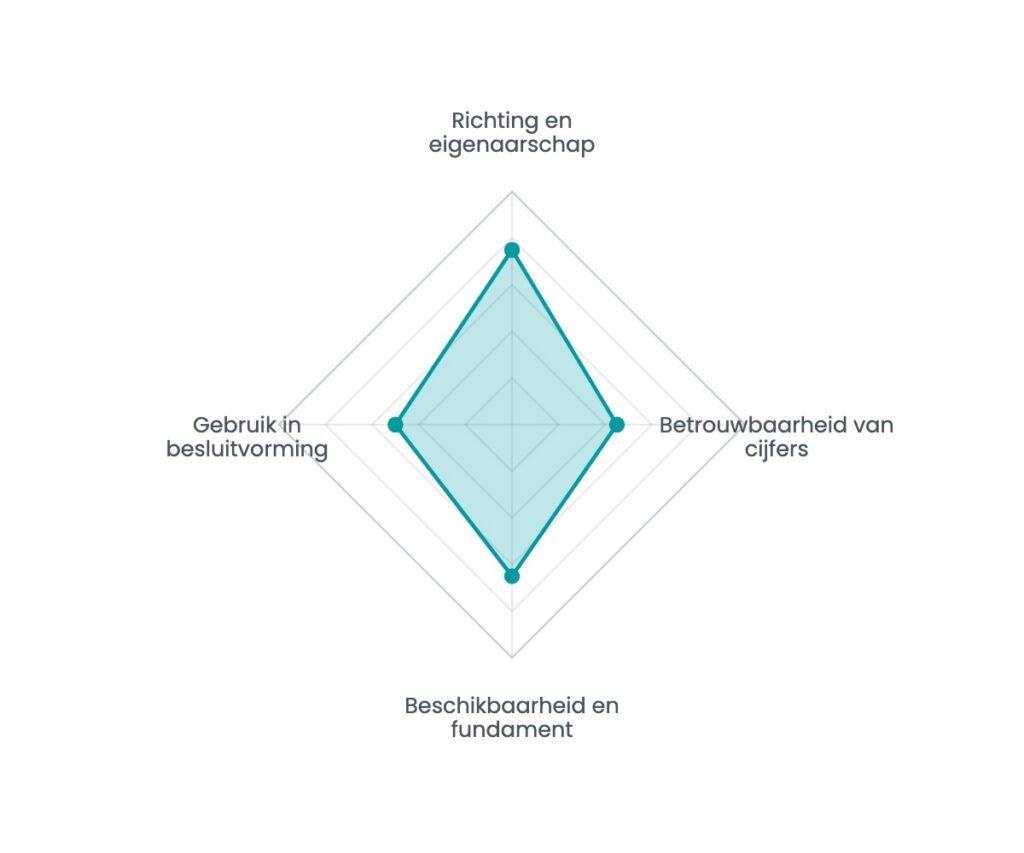
Sixteen questions, seven minutes, and an instant spider chart showing your strongest and weakest dimension. No e-mail address needed to see the result.
AI · 20 October 2026
A model that performs well in testing can deliver less than expected in practice. Learn why trust drives AI value in government and how to measure it.
Read the article →

AI · 18 October 2026
An honest checklist: six questions that determine whether your organisation is ready for AI, and what the next step is if the answer is no.
Read the article →

AI · 18 October 2026
Almost every organisation that gets serious about data faces the same question: who is actually going to do this? Build, hire or outsource?
Read the article →
Work with us
The people who build it also run it afterwards. Eindhoven, since 2014.
We use Google Tag Manager to measure visits and Leadinfo to recognise which company is visiting. Neither loads unless you agree. If you choose essential only, the site works as normal and we measure nothing. Cookie statement · Privacy statement
