Twentynext, a data and AI consultancy in Eindhoven, the Netherlands, offers a free Data Maturity Scan: sixteen questions, about seven minutes, and you see your profile straight away, without entering an email address. It measures four dimensions on five levels each and shows you which dimension is holding the others back. Below is what the scan measures, how it differs from the frameworks published by governments and sector bodies, and how to use the result.
What the scan measures
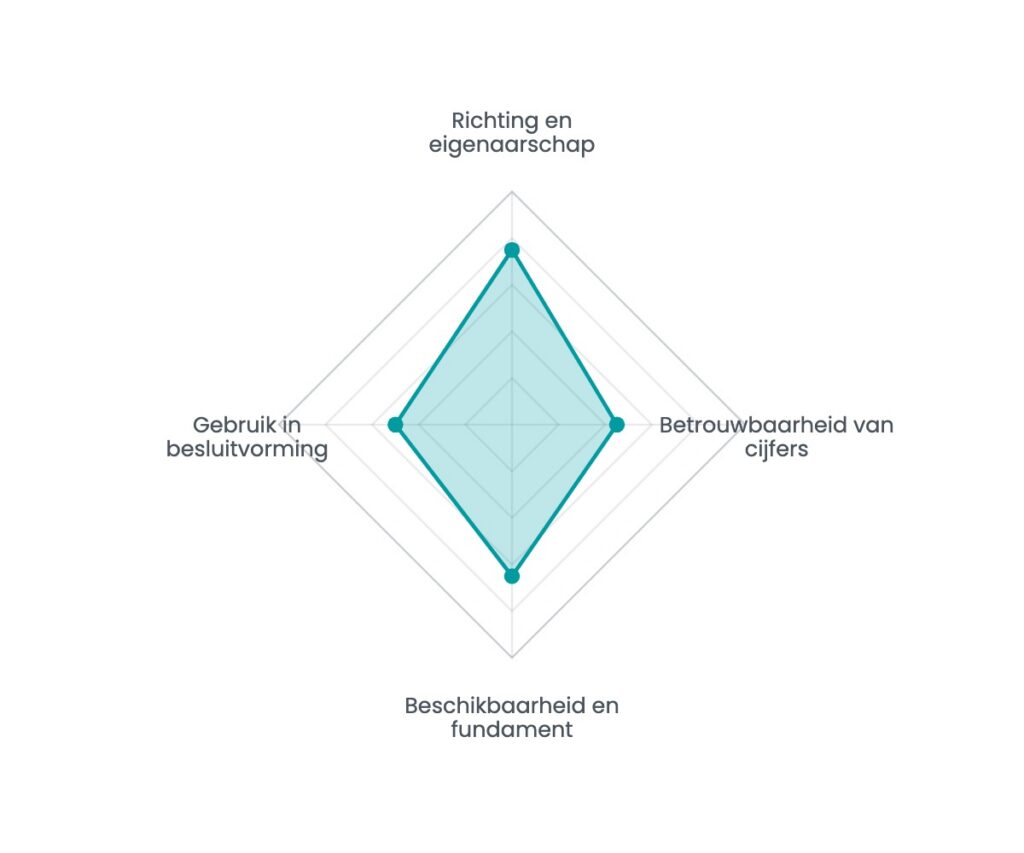
The scan asks sixteen questions about what actually happens in practice, not about what the strategy document says. The answers are scored on four dimensions: direction and ownership, reliability of figures, availability and foundation, and use in decision-making. Two of those four are not about technology but about how decisions are made where you work. That is deliberate: in our projects, that is where most of the work sits.
Per dimension you land on one of five levels, from ad hoc to data-driven. You get no overall score. An average hides exactly where things are out of balance: an organisation with a solid platform and nobody who owns the figures scores the same average as one with clear ownership and no platform, and the two need entirely different first steps. Instead you see per dimension where you stand, which pattern your answers form together, and which dimension is holding the rest back.
How it compares with other data maturity frameworks
Several public frameworks exist, and they are worth knowing. The UK government publishes a Data Maturity Assessment for Government framework, aimed at public bodies and structured across ten topics that intersect with six themes. Data Orchard publishes a Data Maturity Framework used widely in the non-profit sector, with seven themes and five stages. Both are broader frameworks than the Twentynext scan and are often used in facilitated organisational assessments.
The Twentynext scan is a different instrument. It is short by design, so that a director or IT lead can take it alone in seven minutes and then compare notes with colleagues. It is built on established maturity models and on what we encounter in projects, and it is aimed at one question: where should we start? The full methodology, including the four dimensions and the five levels, is published on our methodology page.
What happens with your answers
Your answers stay in your browser. Nothing is sent to us unless you choose to request the full report as a PDF, with your scores per dimension, the interpretation per level and the next steps for your organisation. If you do, we receive your scores and get in touch within one working day. The scan is free and commits you to nothing; neither does the follow-up conversation.
How to use the result
- Take it more than once. Ask two or three colleagues from different departments to take it independently. Where your profiles differ is usually where the real conversation is.
- Look at the weakest dimension first. Investing in the strongest dimension feels productive and changes little. The dimension that is holding the rest back determines what the next step should be.
- Bring it to the conversation. If you talk to a consultancy afterwards, ours or another, the profile means the conversation does not start from zero.
Who the scan is for
For directors, managers and IT leads who want to know where to start, or want to test whether their picture matches that of their colleagues. The questions are about decisions and figures, not about specific tools, so the result is readable whatever your sector.
Take the free Data Maturity Scan: sixteen questions, seven minutes, immediate result, no email address needed. Would you rather go through the results together? Book a 30-minute introduction; we respond within one working day.
References
UK Government, Central Digital and Data Office. (2023). Data Maturity Assessment for Government framework. GOV.UK. https://www.gov.uk/government/publications/data-maturity-assessment-for-government-framework
Data Orchard. (n.d.). Data Maturity Framework. https://www.dataorchard.org.uk/resources/data-maturity-framework
How we make this. AI wrote the first draft and a second AI model from another provider reviewed it. Twentynext is responsible for the content.