

AI · Data · 23 August 2026 ·
Why AI projects run aground on data quality, and what to do about it: start with one use case and put in order only the data that case actually needs.

The AI project started promisingly. The use case was clear, the model ran in a pilot, the first demos looked good. And then came the production phase, and everything ground to a halt. The predictions were off, users did not trust the results, and nobody could point to exactly where it went wrong.
Anyone who has been in this field for a while recognises the pattern. The problem rarely sits in the model alone: the objective, adoption, integration and operations decide just as much whether something succeeds. But in our experience the data is the most stubborn of them, and the least visible for as long as you are still in the pilot phase. Below: why that is, how to spot it before it costs money, and what a realistic approach looks like.
The underlying principle is old and unforgiving: garbage in, garbage out. A system that learns from incorrect, incomplete or inconsistent information produces results that harm your operations rather than improve them.
The treacherous part: you usually see this late. In the pilots we come across, the model runs on a selected or partly cleaned dataset, which makes it look like it performs perfectly well at that stage. The move to production, where the model has to handle the full reality of your organisation, is in our experience the moment the gaps become visible.
On top of that, AI can amplify data quality problems. A wrong figure in a report may catch an attentive analyst’s eye. Model output is often used at a larger scale and with less human intervention, so errors in the underlying data can travel further before anyone notices them.
Data quality is a catch-all term. The four categories below turn up regularly in practice. They are not exhaustive, representativeness, bias and the traceability of data play a part too, but they are good places to start looking.
Customer records in the CRM, transactions in the ERP, contact history in a service desk system, and nowhere a single consistent picture. That means duplicated work and decisions taken on half a picture. For AI there is something on top of that: connections between data that cannot responsibly be linked or made available together stay out of the model’s reach, however good that model may otherwise be.
What is an “active customer”? When does a request count as “handled”? If three departments give three answers, the model is served three contradictory truths. The cause can be technical, organisational, or both, and precisely because it is nobody’s problem alone, it often goes unaddressed.
Empty fields, records that were never updated, the same person or object registered twice. An employee who knows the context can work around it. A model generally does not have that context, and how it handles missing or wrong values depends on choices someone has to make deliberately.
The most structural problem: nobody is identifiably responsible for the data. Errors are noticed, but there is no route to report or resolve them. Without ownership assigned, a cleaned-up dataset is likely to degrade again over time.
You do not have to wait for a large assessment to get a first indication. A simple litmus test that works well in our practice: put your data infrastructure through ordinary analysis first, before you point AI at it.
Can you produce reliable reports on the process you want to point AI at? Do the figures match when you put them side by side from different systems? Do the process owners trust the dashboards that already exist?
If basic reporting already causes argument, “that figure is wrong, my system says something else”, your data is not ready for AI. That is not a disqualification, but it is a clear order of work: solve this first, build models afterwards.
A few additional questions that give a quick read:
A practical rule of thumb: if you are left without an answer to several of these questions, you have found your starting point.
The reflex when facing a data quality problem is a clean-up: a team that scrubs data for a few weeks, after which the project carries on. That can be useful, but as a one-off exercise it is rarely enough. The reason is simple: without processes for data quality your data degrades again, because the source of the pollution, the daily working process, is unchanged.
What does hold up, in our experience: setting up data quality as a continuous process. The core of it:
Agreements on how things are recorded. Decide how new information is registered: mandatory fields, standardised values, no free-text fields where structured data belongs. Much of the pollution starts at data entry, though migrations, interfaces and ageing can be sources too.
Responsibility that is assigned. Appoint an owner for each data source or data domain, responsible for checks and for handling reported anomalies. In many organisations that need not be a full-time role; what matters most is that the role has a name and that it is clear who fills it.
A route for anomalies. Agree what happens when someone finds an error: where to report it, who picks it up, within what period. Without such a route, reports are likely to sit unhandled and people stop bothering to file them.
Monitoring on the core fields. You do not have to measure everything. Pick the data fields that matter most to your AI application and track their completeness and consistency. You want to see deterioration before the model does.
A common mistake is to turn the conclusion around: “our data has to be entirely in order first, so we are starting a three-year, organisation-wide data programme.” That is the other way to run an AI ambition aground, not on bad data this time, but on a project with no end.
The pragmatic route: start with one concrete use case and put in order only the data that case needs. That is a manageable scope, and the lessons you learn along the way, about definitions, ownership, entry discipline, carry over to the next domain.
Be honest about how long it will take. How much time getting data in order costs varies a great deal per use case, organisation and existing infrastructure, but in our experience it is underestimated more often than overestimated. Being realistic about that up front prevents the pressure to go live with poor data anyway.
Data quality is ultimately about trust. Users who see obviously wrong results come out of an AI system lose confidence in that system, and restoring that confidence usually takes more effort than getting it right beforehand.
There is a compliance side too. The GDPR contains an accuracy principle (Article 5(1)(d)): personal data must be accurate and, where necessary, kept up to date. What that means in concrete terms depends on your role, the purpose, the legal basis and the risk of the processing, among other things. The Autoriteit Persoonsgegevens, the Dutch data protection authority, publishes guidance on this; anyone applying AI to personal data would do well to weigh this principle explicitly.
The European AI Act also sets data governance requirements in Article 10 for certain high-risk AI systems, including on relevant quality aspects of training, validation and test datasets. Which obligations apply to your organisation depends on your role, the type of system and the application. This is not legal advice; take advice from a specialist on it. The general direction is clear enough, though: a grip on your data also helps in meeting requirements of this kind.
And for organisations that take decisions affecting people, certainly in the public and semi-public sector, whatever explanation you have to or want to give about a decision AI contributed to, that explanation starts with the question of whether the underlying data is correct.
You do not have to wait for a large programme to begin. Do this:
How long such a baseline takes depends on how accessible your data is, but keeping the scope deliberately small keeps it manageable. The result is a concrete list of improvements instead of a vague feeling that “the data is not in order”.
And if the outcome is disappointing? Then you learned that lesson before a model was built on top of it. That is exactly the difference between AI projects that run aground and projects with a real chance. If you would rather run that baseline with us, that is exactly where our data consultancy starts.
How we make this. AI writes the first version, a second AI checks it, and a person at Twentynext read and approved this article before it went live. We check facts and sources carefully, but cannot guarantee that they are accurate or complete. See our disclaimer.
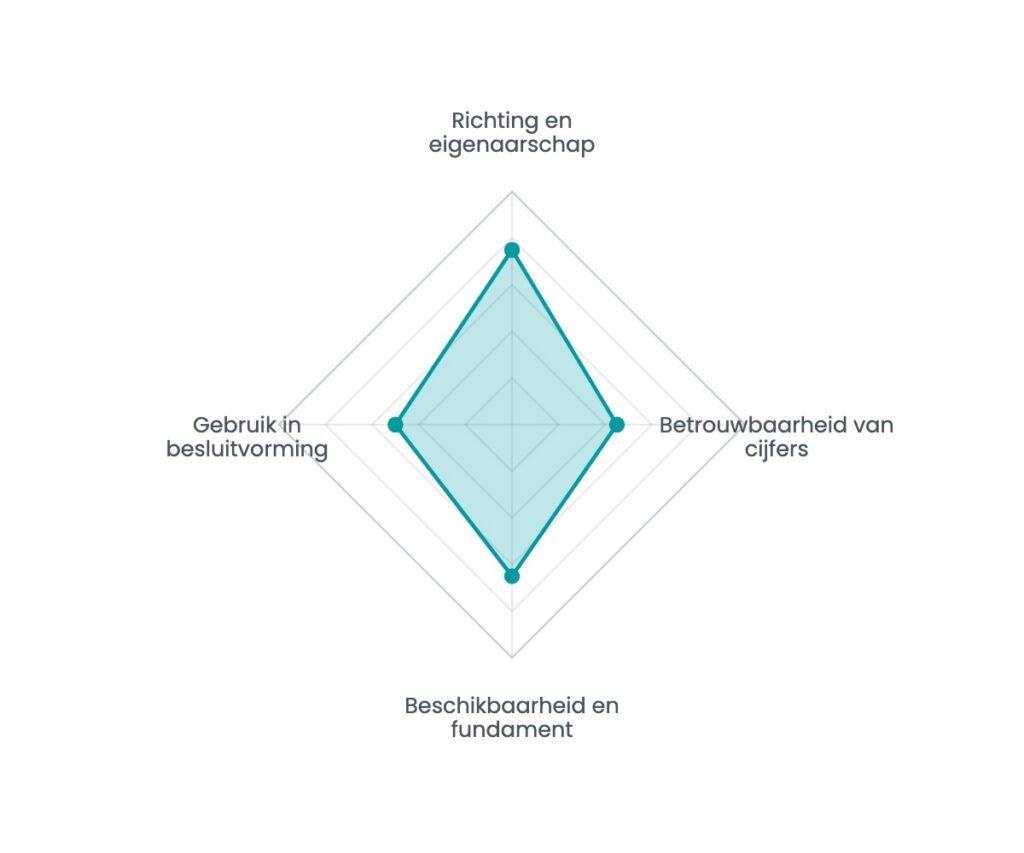
Sixteen questions, seven minutes, and an instant spider chart showing your strongest and weakest dimension. No e-mail address needed to see the result.
AI · 5 November 2026
Looking for a consultancy to build an AI data platform? Agency websites look alike. Learn which three things set them apart and the seven questions to ask.
Read the article →

AI · 5 November 2026
On paper, the business case for an AI application often looks straightforward: licences, a model, development hours and a three-month pilot.
Read the article →

AI · 20 October 2026
A model that performs well in testing can deliver less than expected in practice. Learn why trust drives AI value in government and how to measure it.
Read the article →
Work with us
The people who build it also run it afterwards. Eindhoven, since 2014.
We use Google Tag Manager to measure visits and Leadinfo to recognise which company is visiting. Neither loads unless you agree. If you choose essential only, the site works as normal and we measure nothing. Cookie statement · Privacy statement
