

AI · 5 November 2026 ·

Translated with AI. From our Dutch article. See our disclaimer.
On paper, the business case for an AI application often looks straightforward: licences, a model, development hours and a three-month pilot. Suppose that six months later the team is still working on the input side. Fields turn out to be filled differently than expected, two systems use a different customer number and nobody knows who manages the source.
Such costs are not always in the budget, and they can help determine whether a project pays off. Below you can read where they come from, which architecture choices cause them and how you make them visible in advance instead of discovering them afterwards.
In a budget, the line item “AI” may mainly cover the model, the tooling and the team that builds it. The work around it, such as finding, understanding, correcting, linking and maintaining data, can then drop out of view.
ITS Value estimates that hidden costs for data and infrastructure can easily double or triple the visible costs of AI. That is an estimate from that source and not a general expectation for every project. Stratalytic calculated five SME projects and arrives at EUR 10,000 to 60,000 per project for those projects, with complexity and data quality as the determining factors (as at November 2026). Those are outcomes of that calculation and not representative figures for Dutch organisations; how the projects were delimited can be read in the source itself.
That last point is the core: in such a calculation, data quality stands as a cost factor alongside complexity. If a project stalls, it pays to look at the data side first before questioning the model. Time can be spent on finding out why two reports give a different total, and who is allowed to decide on that.
Poor data can have a cause in the architecture. Anyone looking for the cause can, for example, check whether copies of datasets without an owner exist, whether definitions differ per department, whether input is validated and whether integrations were once built as a one-off export.
An AI project can make those weak spots visible. An employee reading a report can sometimes recognise a deviating field themselves. With a model, that depends on the application and the checks that have been set up around it.
An obvious route is to clean up per project. In that case, check whether the correction is also applied in the source. Datakingdom describes a related problem: without reliable and well-structured data, AI projects remain stuck in the experimentation phase.
Eltjo Poort of CGI writes that architecture derives its value from decisions that are costly, far-reaching or risky to reverse later. In AI projects, those decisions can be taken implicitly, by the first team that needs something that works.
Decisions worth taking explicitly in advance:
Besides the technical elaboration, these points require agreements between teams that rarely encounter each other in the line organisation.
Radu Vunvulea describes why AI ROI is more volatile than that of classical IT projects, among other things because the costs can rise with usage.
A change in a source system, such as a new field, a changed code table or a migration, can disrupt the chain. So determine in advance how you will notice such a break, for example with monitoring of data quality or other checks.
A survey by Jitterbit from August 2026 reports that 78 per cent of AI projects are already delivering added value. That is an outcome of that survey and not a representative figure for Dutch organisations. What the survey understands by “AI projects” and “added value” can be read in the source itself; without that delimitation, the percentage is difficult to interpret. The costs of maintaining the data supply also count towards the margin.
The honest conclusion: the ROI of an AI application can only be assessed once the ongoing data costs are included. A pilot that leaves that out of view can give too rosy a picture.
A number of measures that help you avoid having to revise a budget halfway through.
Include a separate line “data” in the business case, split into one-off (opening up, cleaning, linking) and ongoing (management, monitoring, adjustments following source changes). Two scenarios side by side, an optimistic and a realistic one, force the conversation that you would otherwise only have later.
Carry out a short data readiness check for each use case before you commit development capacity. Which sources, who is the owner, how fresh is the data, which quality problems are already known. Such a check can help bring problems that are already known to the process owner to the table before the team starts on them.
For the first use cases, weigh up whether a shared access layer or separate connections fits better. Questions that help here: how many applications need the same sources, and who manages the connections when there are more of them?
Establish ownership before the project starts. That does not have to be a full-time position, but it must be someone’s task to decide on definitions and quality.
Be realistic about lead times. Choose a narrow path: the few sources that this one application needs, properly opened up and with an owner, and expand from there.
Take one AI application that you have planned or that is already running. On one A4 sheet, list all the data sources it needs, and note four things per source: the source system, the owner, the refresh frequency and the known quality problems.
You can best fill that in together with the process owner and a data engineer. The empty boxes on that A4 sheet point to possible costs or risks.
With that list in hand, you can make a well-founded choice: solve it within the project, or arrange it structurally because the next use case needs the same sources. Both are defensible. Not choosing is the expensive option.
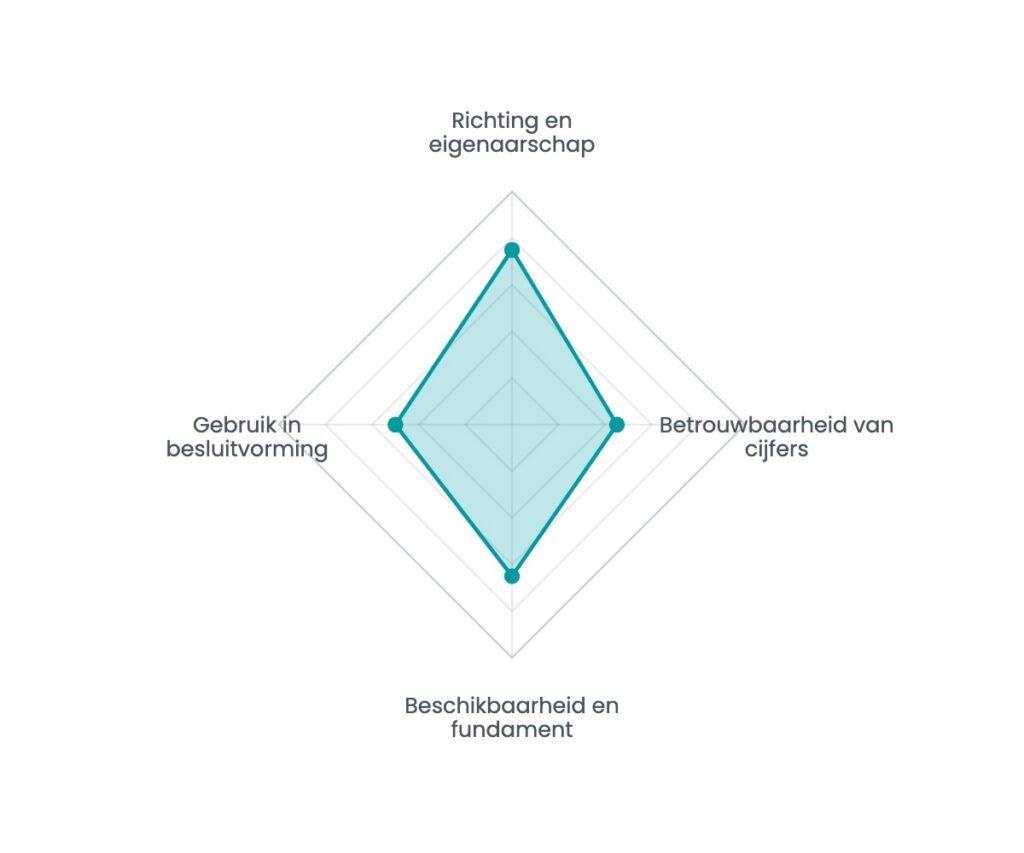
Sixteen questions, seven minutes, and an instant spider chart showing your strongest and weakest dimension. No e-mail address needed to see the result.
AI · 5 November 2026
Looking for a consultancy to build an AI data platform? Agency websites look alike. Learn which three things set them apart and the seven questions to ask.
Read the article →

AI · 20 October 2026
A model that performs well in testing can deliver less than expected in practice. Learn why trust drives AI value in government and how to measure it.
Read the article →

AI · 18 October 2026
An honest checklist: six questions that determine whether your organisation is ready for AI, and what the next step is if the answer is no.
Read the article →
Work with us
The people who build it also run it afterwards. Eindhoven, since 2014.
We use Google Tag Manager to measure visits and Leadinfo to recognise which company is visiting. Neither loads unless you agree. If you choose essential only, the site works as normal and we measure nothing. Cookie statement · Privacy statement
