

AI · 5 November 2026 ·

Translated with AI. From our Dutch article. See our disclaimer.
Anyone looking for a consultancy to help with an AI data platform sees websites that look very much alike. At various firms you read variants of support “from start to finish”, with attention to governance and a foundation for AI. You cannot choose a partner on the basis of those texts.
The difference lies in three things: whether a firm also builds, whether it also manages, and how honest it is about what your organisation has to arrange itself. Those three say more about what you will have in hand after delivery than the texts on the website.
It helps to see a data platform that has to support AI as three kinds of work: advisory work, build work and management work. The advice concerns architecture choices, which sources are connected first, who owns which data and which applications are worth the effort.
The build concerns pipelines, storage, access management, an environment in which models run and the integration with the systems where the work is done.
Management begins on the day the builder leaves. Think of monitoring data quality, costs, permissions and the connections with source systems. This part deserves its own place in your request for proposals, because it continues for as long as the platform exists.
So ask every firm which of the three assignments it carries out itself, and which it leaves with you or with a third party.
These firms present themselves with a broad offering. For example, as of October 2026 Neurons Lab describes Accenture’s offering as including strategy and roadmap, “data readiness and enterprise data foundation for AI”, responsible AI adoption and staff training.
This model suits organisations that want to run a multi-year programme with many components at the same time and can bear the corresponding scale. In that case, ask how the people who will use the platform daily are involved in the design.
With these parties the emphasis is in many cases on the stack of the vendor they work with. Software vendors of data platforms also offer services themselves; the blog by Acceldata on building an AI data platform, for example, ends in a description of its own product.
There is nothing wrong with that, as long as you know it. Bear in mind that the advice may then start from that stack. If you want to keep that choice open, the advice should sit with a different party than the build.
Smaller firms that are strong in models, analyses and applications. Data Science Partners positions itself as of October 2026 as an AI consultancy that “ontzorgt van begin tot eind” (takes care of everything from start to finish).
The strength is knowledge of the applications themselves. The question you need to ask is how much data engineering and management capacity sits behind it. A good model delivers little if the pipelines beneath it are not managed stably.
A fourth group offers strategy and platform build within a single offering. As of October 2026 Devoteam lists “AI-strategie” (AI strategy) and “AI Tech Foundations” as services; Valcon describes “Data & AI Platform Engineering” as part of its data offering. Whether such a firm also handles management after delivery is not clear from these pages. Ask about that explicitly.
If advice, build and management sit with one team, the person who designs the platform knows they will also have to manage it later. That can lead to manageability being weighed in the design from the start. Also ask whether the size of the team matches the size of your programme.
Websites give you the category. The first conversation gives you the quality. These questions help with that.
The answers do not all have to be perfect. Pay particular attention to where a firm becomes reticent. That is where the work lies that the firm would rather leave with you.
A platform without an owner on your side stops working as soon as the first priorities shift. Someone in your organisation has to “own” the platform: budget, decisions about new sources, the relationship with the management team. That does not have to be a full-time role, but it does have to be someone’s responsibility.
Each data source needs an owner who decides on quality, access and use. Expect this to take time, because it requires conversations with departments that have little direct interest in it.
When processing personal data, questions arise such as the legal basis on which a processing operation rests, who is responsible for what and which agreements are needed if another party processes data on your behalf. Which obligations apply in your situation is a question for your privacy and legal functions. Whether the AI Act is relevant to an application is a question to discuss with your legal function. Expect involvement of your privacy and legal functions from the design stage.
On lead time, we would rather say something conservative than something attractive. How long a first working application on a new platform takes depends heavily on the starting situation; sources, agreements and access can take up a large part of that time. If a firm promises a short lead time, ask what exactly will be running after that period.
For Twentynext, the same seven questions apply as for any other firm. Our starting point is that a platform should be designed by people who know the management consequences.
If the source data do not yet have an owner, if nobody in your organisation is going to carry the platform, or if the first application is not yet clearly defined, we would rather discuss that before the quotation than after it. Building a platform for an organisation that is not yet ready for it benefits nobody.
If what you mainly want is a strategic programme with hundreds of people, there are parties that are better set up for that. If you want a platform that is still running in two years’ time and that your own people understand, then our approach is a fit.
Before the first conversation with a firm, write a one-page (A4) request. It states which application you want first, which sources are needed for it and who owns them, what you expect in terms of management after delivery, and what budget you have reserved for both build and management.
Send that page to three firms from different categories and set the answers against the seven questions above. For each firm, note which open points on your A4 it identifies itself and how it proposes to fill them in.
If you would like to have that request checked before it goes out, a Twentynext consultant will read it through with you.
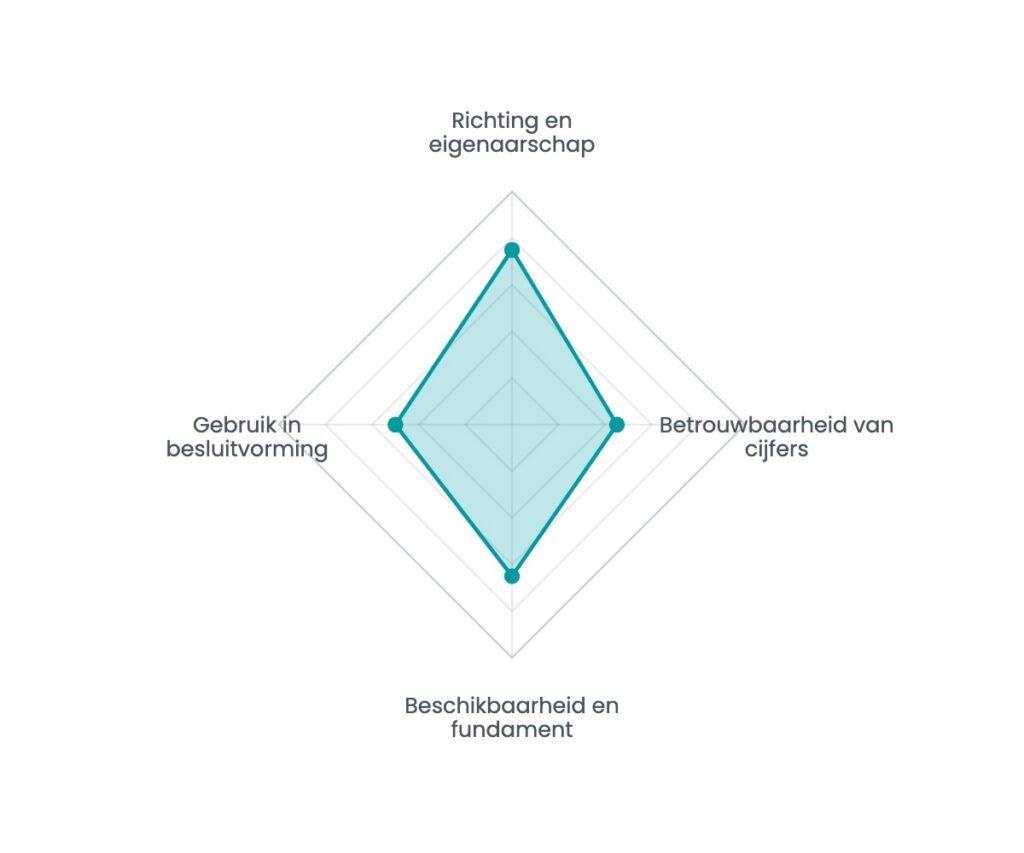
Sixteen questions, seven minutes, and an instant spider chart showing your strongest and weakest dimension. No e-mail address needed to see the result.
AI · 5 November 2026
On paper, the business case for an AI application often looks straightforward: licences, a model, development hours and a three-month pilot.
Read the article →

AI · 20 October 2026
A model that performs well in testing can deliver less than expected in practice. Learn why trust drives AI value in government and how to measure it.
Read the article →

AI · 18 October 2026
An honest checklist: six questions that determine whether your organisation is ready for AI, and what the next step is if the answer is no.
Read the article →
Work with us
The people who build it also run it afterwards. Eindhoven, since 2014.
We use Google Tag Manager to measure visits and Leadinfo to recognise which company is visiting. Neither loads unless you agree. If you choose essential only, the site works as normal and we measure nothing. Cookie statement · Privacy statement
